
Movement
One point orthogonally
RULE GUIDE · GENERAL
One point inside the palace, never facing the enemy general
The general moves one point orthogonally and never leaves its palace. The two generals may not face each other along an open file — the flying general rule — and a player who creates that position has made an illegal move.
Practise on a real board→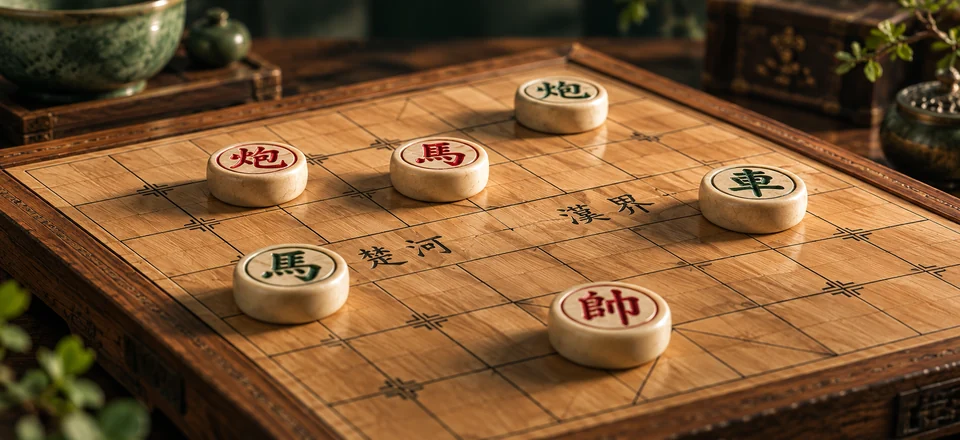
One point orthogonally
Generals may not face each other
Checkmate or stalemate wins
The general steps one point along a rank or file. It cannot move diagonally and cannot move two points at once.
The palace limits it to nine points in total, which is why the general needs advisors and elephants around it.
If both generals end up on the same file with no piece between them, the position is illegal. A player who creates it has made an illegal move and must choose another.
This rule matters constantly in practice: it forbids natural-looking general moves, and it is a common mating mechanism in endgames, because the enemy general can be frozen by the threat of facing yours.
If a general is in check and has no legal way to escape, that is checkmate and the player loses. If a player is not in check but has no legal move at all, that is stalemate — which also loses in xiangqi, unlike international chess.
Perpetual checking by one side is illegal: that side must change its moves or lose. If neither side can make progress, the game is drawn.
FAQ
No. Two generals on the same file with nothing in between is an illegal position, and the move that creates it is void.
No. The general can never leave its own three-by-three palace.
A player with no legal move who is not in check loses the game; this is called stalemate or 困毙.
No. One-sided perpetual check is a foul; the checking side must vary or lose.
Updated
Ready to make the first move?
Practise on a real board