
Movement
Any distance in a straight line
RULE GUIDE · CHARIOT
Any distance along a rank or file, with a clear path
The chariot moves any number of points along a rank or file and cannot jump over a piece. It captures by moving onto an enemy piece, exactly like a rook in international chess.
Practise on a real board→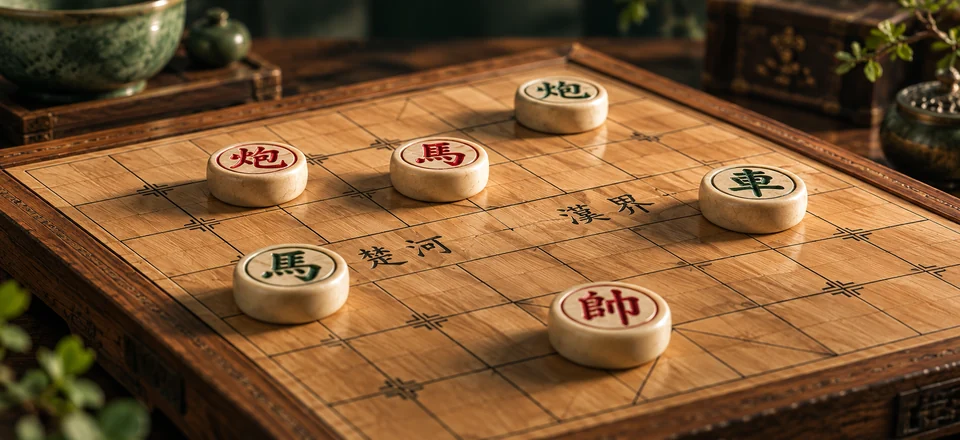
Any distance in a straight line
The path must be empty
Usually the strongest piece
A chariot slides along its rank or file for any number of points, as long as no piece blocks the way. It never moves diagonally and never jumps.
Capturing uses the same movement: move the chariot onto the point occupied by an enemy piece. It can capture forwards, backwards or sideways, but not through a blocker.
The emptier the board, the more points a chariot controls, so the standard opening priority is to open lines for it. A chariot stuck behind its own soldiers is worth far less than an active one.
In most xiangqi positions the material order is chariot, then cannon, then horse, and the chariot is usually the piece that decides endgames.
Place a chariot on an open file or rank and it controls many points at once. Two chariots that protect each other can alternate checks and are one of the simplest mating combinations in the game.
FAQ
No. It only moves along ranks and files; diagonals belong to the horse, elephant and advisor.
No. Any piece on its path blocks it completely, which is exactly where it differs from the cannon.
In most positions yes. Its range is never limited by a blocked horse leg, and that matters most in endgames.
Move the blocking piece, or switch the chariot to an open rank or file so its range returns.
Updated
Ready to make the first move?
Practise on a real board