
Movement
Same straight lines as a chariot
RULE GUIDE · CANNON
A rook that needs exactly one screen to capture
A cannon moves exactly like a chariot: any distance along a rank or file with a clear path. To capture it must jump over exactly one piece — the screen — and land on an enemy piece beyond it.
Practise on a real board→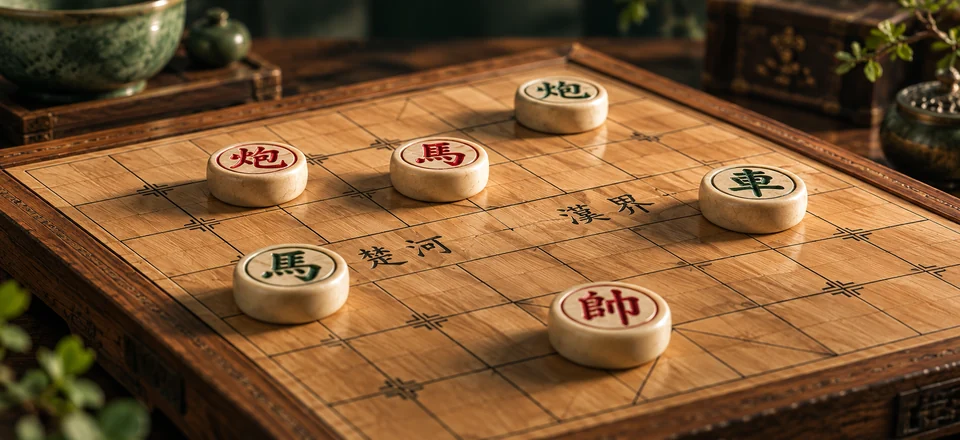
Same straight lines as a chariot
Exactly one screen piece
Any piece from either side
When it is not capturing, the cannon slides any distance along a rank or file, and its path must be empty. In that respect it is identical to a chariot.
The difference appears only on captures: moving never needs a screen, capturing always does.
To capture, the cannon needs two things: the target must be on its line, and exactly one piece must stand between the cannon and that target. That piece is the screen, and it can belong to either side.
With no screen the cannon cannot capture along that line, and with two or more pieces in between it also cannot capture. This single detail causes more beginner mistakes than any other xiangqi rule.
Cannons are usually stronger than horses in the middlegame: they check from a distance and can use the enemy advisors and elephants as screens to attack the palace.
Central cannons and doubled cannons on the same file are classic attacking setups. Their weakness is the endgame, where an empty board leaves few screens.
FAQ
Yes. Movement along an empty line never needs a screen; only the capturing move does.
Yes. Screens can be friendly or enemy pieces; the rules do not distinguish.
No. It needs exactly one piece in between — one too few or one too many both cancel the capture.
In the middlegame, usually yes, because screens are plentiful and it checks from far away. On an empty board the horse often becomes more useful.
Updated
Ready to make the first move?
Practise on a real board